
How to Stop Rising Damp & Leaking Retaining Walls: Western Cape Winter Waterproofing

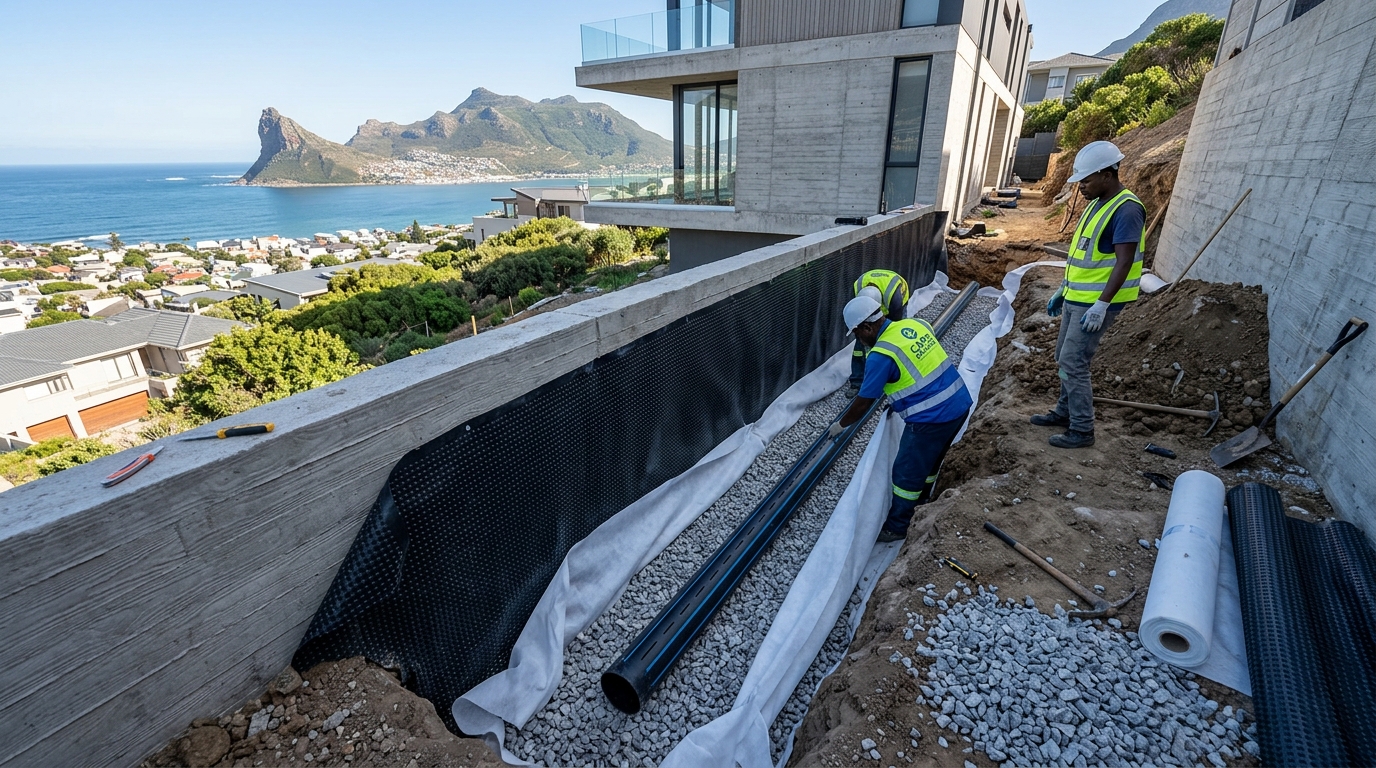
- The Western Cape winter climate (prolonged soaking cold fronts and saturated clay soil) exposes any flaw in a building’s damp-proof course (DPC) and subsoil drainage.
- Rising damp is caused by capillary action drawing groundwater up through porous bricks, depositing destructive hygroscopic salts that blow off interior paint and plaster.
- Retaining wall waterproofing requires a two-pronged approach: positive-side hydrostatic barrier membranes and a continuous geotextile-wrapped subsoil drainage pipe.
- Painting over damp walls with standard PVA or gloss enamel traps moisture inside the brickwork, accelerating internal brick decay.
- Civil engineering chemical DPC injection and crystalline slurry waterproofing provide permanent, warrantied moisture barriers.
1. The Western Cape Winter Rain Challenge
Why Cape Winters Are Brutal on Building Envelopes
Unlike South Africa’s summer-rainfall provinces where rain occurs in brief afternoon thunderstorms, the Western Cape endures sustained, multi-day winter cold fronts. When continuous rain saturates the clay-rich soils of Somerset West and the Helderberg basin, immense hydrostatic ground pressures build up against foundation footings and subterranean retaining walls.
If a home’s waterproofing membranes or sub-surface drainage systems are compromised, moisture rapidly penetrates the structure—leading to bubbling paint, toxic black mould, crumbling plaster, and musty living conditions.
2. The 3 Types of Damp: Rising, Lateral & Condensation
Accurate Diagnosis is the Key to Permanent Elimination
Treating damp successfully requires correctly identifying the root moisture source:
| Damp Classification | Root Cause | Visual Symptoms | Correct Engineering Treatment |
|---|---|---|---|
| Rising Damp | Capillary suction of groundwater through porous bricks due to missing/bridged DPC plastic | Tide marks up to 1.2m above floor level, white fluffy salt efflorescence, decaying skirting boards | Chemical DPC pressure injection + salt-retardant replastering |
| Lateral Penetration | Hydrostatic ground pressure pushing water sideways through earth-retaining walls | Wet walls at any height where ground is higher outside, peeling paint, water seepage at wall-floor joint | Excavation, positive-side bituminous/torch-on membrane + slotted agi-pipe drainage |
| Condensation Damp | Poor ventilation and cold thermal bridging inside modern airtight rooms | Black mould on cold ceiling corners, window sills, and behind wardrobes | Mechanical extraction fans, double-glazed windows, and thermal ceiling insulation |
3. Retaining Wall Subsoil Drainage & Bidim Engineering
Why Most Retaining Walls Leak After 3 Years
Retaining walls on sloped Somerset West properties frequently fail because previous builders skipped essential sub-surface filtration layers.
When dirt is backfilled directly against a wall without a geotextile filter, fine silt quickly clogs drainage weep holes. Water pools behind the wall, creating crushing hydrostatic head pressure.
JXT Construction engineers robust retaining wall drainage systems:
4. Positive-Side vs Negative-Side Waterproofing
Stopping Water Before It Enters vs Blocking It from the Inside
Positive-Side Waterproofing (Exterior): Applied to the outside face of the wall in contact with the wet soil (4mm torch-on bituminous membrane or rubberized bitumen). This is the gold standard because it stops moisture from ever entering the brickwork.
Negative-Side Waterproofing (Interior): When exterior excavation is impossible (e.g. boundary wall next to a neighbour’s driveway), high-strength crystalline polymer slurries (e.g. Vandex or SikaTop Seal) are applied to the interior face. Crystalline chemicals migrate into the concrete capillaries, forming insoluble microscopic crystals that block water under pressure.
5. Chemical DPC Pressure Injection Systems
Creating a New Waterproof Barrier Without Demolishing Walls
When a 30-year-old home suffers from deteriorated damp-proof course plastic, demolishing the brickwork is impossible. JXT Construction installs specialized silane-siloxane chemical DPC injection barriers:
Drilling Pattern: Holes are drilled at 100mm intervals along the mortar bed joint just above exterior ground level.
Pressure Injection: Concentrated hydrophobic silicone cream is injected under controlled pressure, diffusing into the mortar and masonry to create a continuous, permanent water-repellent barrier.
6. Salt Neutralisation & Plaster Remediation
Why You Cannot Paint Over Salt-Contaminated Walls
Groundwater contains dissolved mineral nitrates and chlorides. As moisture evaporates from interior walls, these hygroscopic salts crystallize inside the plaster. Even after installing a new DPC, old salt-laden plaster will continuously absorb humidity from the room air and bubble paint.
The only lasting solution is hacking off contaminated plaster 500mm above the highest damp line, treating the raw brickwork with a salt-neutralising fluid, and applying a dense sand-cement plaster modified with SBR waterproofing bonding liquid.
7. Autumn Pre-Winter Maintenance Checklist
Prepare Your Home in April & May Before the Heavy Rains Arrive
1. Inspect and clear all roof gutters, downpipes, and stormwater catchpits.
2. Check exterior ground levels: Ensure garden soil and flowerbeds have not been piled up above the sub-floor DPC line.
3. Clear subsoil drain discharge outlets and test weep holes in retaining walls with a high-pressure hose.
4. Reseal parapet wall flashings and balcony expansion joints with polyurethane UV-resistant sealants.
8. Professional Waterproofing with JXT Construction
Civil Engineering Diagnostics and Guaranteed Moisture Control
Do not let another wet Western Cape winter damage your property investment. JXT Construction Projects combines civil engineering diagnostic technology with certified industrial waterproofing systems to solve moisture problems permanently.
Contact Jacobus Theart today for a comprehensive on-site damp and drainage inspection in Somerset West, Strand, Gordon’s Bay, or Cape Town.
Frequently Asked Questions
Get direct, verified answers regarding construction regulations, timelines, and costs in Somerset West & Western Cape.
Jacobus Theart
Civil Engineer & Managing Director • WBHO & Afriline Civils Veteran
Jacobus holds a National Diploma in Civil Engineering from CPUT (2009) and brings 15+ years of Tier-1 civil and structural construction leadership across the Western Cape. He personally oversees every JXT residential and commercial build in Somerset West, Strand, and Cape Town.