
Concrete Spalling & Cracked Balconies: Coastal Western Cape Repair Guide

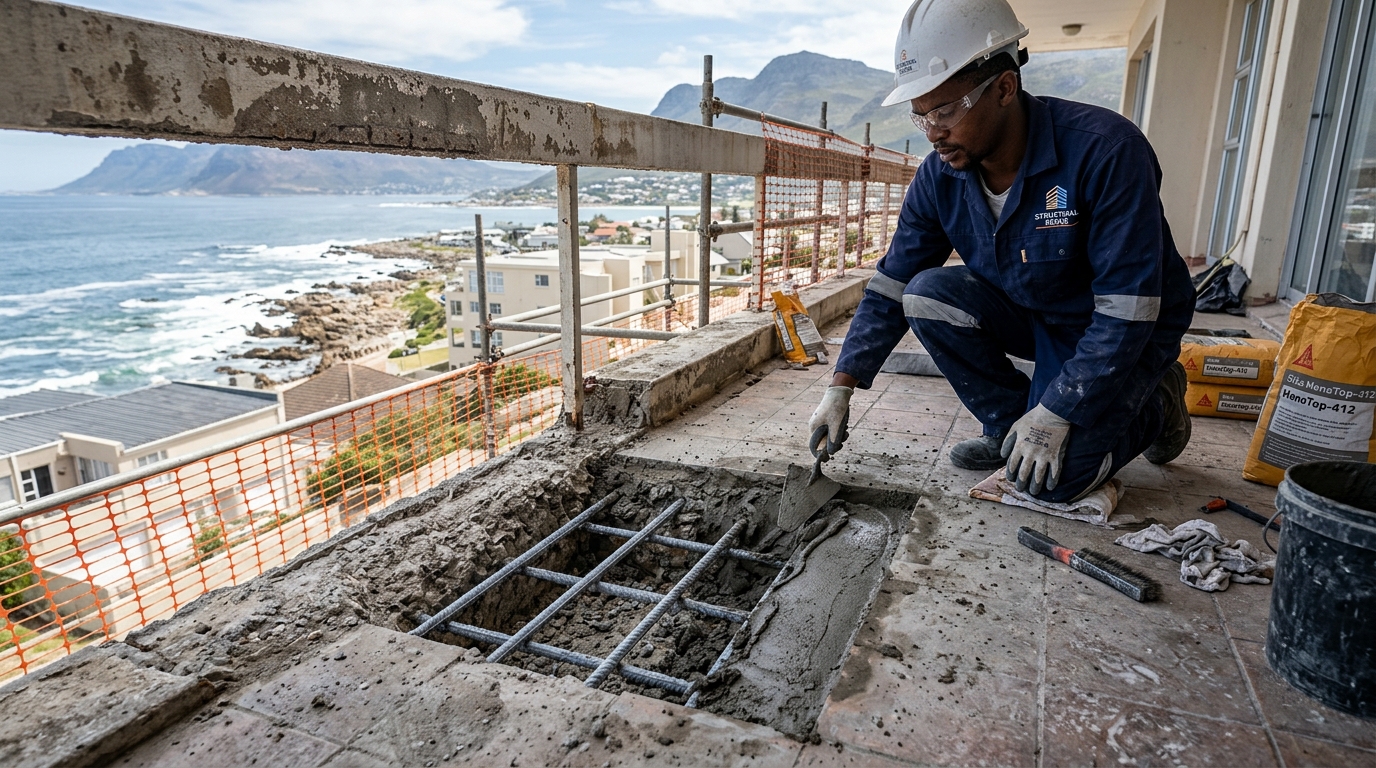
- Concrete spalling occurs when marine airborne chlorides penetrate porous concrete, corroding the embedded steel rebar and causing it to expand up to 600% in volume.
- Smearing ordinary cosmetic plaster or filler over spalling cracks will fail within 6 months and conceals worsening internal structural degradation.
- Permanent structural rehabilitation requires full breakout behind the rebar, abrasive cleaning, zinc-rich active anti-corrosion primers, and SABS-certified polymer repair mortars.
- Defective concrete window lintels and balcony perimeters pose severe collapse hazards if left unaddressed.
- Applying an elastomeric anti-carbonation hydrophobic barrier coating seals the repaired concrete against future salt-mist moisture penetration.
1. What is Concrete Spalling & "Concrete Cancer"?
Recognising the Warning Signs on Coastal Properties
Concrete spalling—often colloquially termed "concrete cancer"—is one of the most destructive and visually alarming structural defects affecting residential and commercial buildings across the Western Cape coast.
Property owners in Strand, Gordon’s Bay, and Somerset West frequently observe brownish rust stains bleeding through exterior plaster, bulging render, hairline horizontal cracking along balcony edges, and chunks of concrete detaching and falling from ceilings and window lintels.
2. The Chemical Mechanism: Chlorides & Carbonation
The Destructive Force of Rusting Reinforcement Steel
Concrete is naturally alkaline (pH 12.5 to 13.5), which creates a microscopic passive oxide layer protecting embedded high-tensile steel rebar from corrosion.
In marine coastal environments, two destructive processes neutralize this protection:
3. Why Cosmetic Plastering Always Fails
The Dangerous Illusion of a Quick Patch Job
Many general handymen and uninformed builders simply chip off loose flaking plaster, fill the void with standard building plaster or Polyfilla, and paint over the area.
This practice does not arrest the electrochemical oxidation occurring on the steel. Deprived of oxygen, the steel continues to corrode rapidly underneath. Within 6 to 12 months, the patch blows off, often taking larger sections of structural concrete with it.
4. The 5-Step Civil Engineering Repair Protocol
How JXT Construction Restores Structural Integrity
True structural rehabilitation requires a disciplined, multi-stage engineering method complying with SANS concrete repair standards:
5. High-Risk Zones: Balconies, Soffits & Lintels
Addressing Structural Collapse Hazards
Certain building components carry extreme risk when spalling occurs:
Cantilevered Balconies: Because cantilever slabs rely entirely on top-layer tension rebar, severe steel corrosion directly compromises structural load capacity.
Precast Concrete Window Lintels: Corroded lintels sag under the weight of upper brickwork, causing diagonal step-cracks and binding window frames.
Coastal Parapet Walls: Uncapped boundary and roof parapets absorb standing rainwater, feeding moisture directly down into floor slabs.
6. Polymer-Modified Mortars vs Micro-Concrete
Selecting the Correct Specialized Repair Materials
Depending on the depth and volume of the breakout, specialized repair chemistries must be utilized:
| Repair System | Application Method | Compressive Strength | Ideal Usage |
|---|---|---|---|
| Polymer-Modified Thixotropic Mortar | Hand-applied / troweled in layers up to 35mm | 45 MPa to 55 MPa at 28 days | Overhead ceiling soffits, vertical columns, and balcony edges |
| Self-Compacting Micro-Concrete | Poured into watertight timber formwork | 60 MPa to 70 MPa at 28 days | Deep structural repairs (>50mm), column jacketing, beam encasement |
| Fairing Mortar Skim | Thin-layer smoothing (1mm - 3mm) | 30 MPa | Sealing concrete pores prior to protective coating application |
7. Anti-Carbonation & Hydrophobic Barrier Systems
Long-Term Protection Against Western Cape Coastal Salt Mist
Following mortar repair, the entire facade should be treated with a high-performance protective coating system. Silane-siloxane hydrophobic impregnations penetrate deep into the concrete pores, repelling liquid moisture while allowing water vapour to breathe out.
This is followed by an elastomeric anti-carbonation paint that bridges hairline cracks and blocks CO2 ingress for over 15 years.
8. When to Call a Registered Civil Engineer
Protect Your Family and Asset with JXT Construction
If you notice brown rust streaks, cracked concrete lintels, or hollow-sounding plaster on your property, immediate diagnostic intervention is critical. Catching spalling early reduces repair costs by up to 80% compared to full structural slab replacement.
Contact Jacobus Theart (Civil Engineer) at JXT Construction Projects for an on-site structural assessment across Somerset West, Strand, Gordon’s Bay, and Cape Town.
Frequently Asked Questions
Get direct, verified answers regarding construction regulations, timelines, and costs in Somerset West & Western Cape.
Jacobus Theart
Civil Engineer & Managing Director • WBHO & Afriline Civils Veteran
Jacobus holds a National Diploma in Civil Engineering from CPUT (2009) and brings 15+ years of Tier-1 civil and structural construction leadership across the Western Cape. He personally oversees every JXT residential and commercial build in Somerset West, Strand, and Cape Town.